 |
| Thank you so much for the break from hagiography |
It takes a lot of balls to name one's
script “Magnum Opus.” regardless of the story one is telling.
Nevertheless, I can't really fault Donald Todd on this one. He and
director Doug Aarniokoski did great work on the piece. That
doesn't mean I don't have issues because I do, and some of them are
rather serious. But let's just say that any episode which gives us
not one but two sword-fights between Abraham and Ichabod, filled with
fabulous, character-developing exposition; a Gorgon; both Katrina and
Abraham getting to be funny, even for a moment; George Washington
being called out as our liar-in-chief; and a gorgeous Excalibur beat
for Ichabod, deserves a little celebrating.
Todd achieves what is, in my mind, a
minor miracle in Act One, when he deftly and believably introduces our theme, our heroes' mission, our villains, their goals, our C
story, some fine detective work, and a good scare all before the
first commercial break, but with such fine story-telling it
doesn't feel at all like he's going through a checklist. The pace is
fast but comprehensible, despite being set almost entirely in the
archives, trusting in the relationship between Abbie and Crane for
its power; the exposition doesn't feel like exposition; not a single
line is wasted.
The episode's theme is introduced in
the very first line, which I appreciate, when Crane says, “the
question is, who am I?” Using the
serious-Ichabod-face-to-introduce-funny-scene trope we've seen a
little too much for my taste, we're off and running. Abbie and Crane
exposit well why they're playing the “who am I?” game; it's a
technique, Abbie explains, which criminal profilers use to distract
their conscious minds so that their subconscious minds can more
effectively problem-solve. They're struggling to find the weapon for
defeating Moloch hidden in Grace Dixon's journal. Abbie's hint to
Crane for George Washington-- “I cannot tell a lie"–leads
adorably to Crane tapping himself on the nose and guessing, “Oh,
oh! The little wooden puppet boy!” When Crane sees “he” is
George Washington, he admonishes Abbie with some marvelous historical
truth-speaking about glorious George. “He was our liar-in-Chief”!!
(Just out of curiosity, how in the hell was Crane ever going to
give Abbie clues about Cher?!)
Katrina figures out how to use Team
Evil's mirror-phone to inform Crane and Abbie that she
has--shockingly--failed in her mission to kill Moloch. I love the
look on Abbie's face on hearing the news. She's so not surprised this
intel doesn't even slightly throw her. Again, Katrina proves herself
the weakest link because not only has she failed in her mission, but
now thanks to her reporting said failure, Henry, using some of sort
of warlocky *69, is able to open a clear line to the Archives and
begins bugging Team Stop-the-Apocalypse's HQ.
Thus we come to Val's issue #1 with
this week's episode: Henry couldn't figure out a way to bug Team
Stop-The-Apocalypse HQ without this trick? I mean, it's not
like he doesn't know where they are. It's not like he can't break in
at any time. It's not like he's not a friggin' immortal warlock
and the Horseman of War, who hangs out with the immortal
Horseman of Death, or anything, and therefore can easily kill all
of them wbenever he wants!?!?!?! (I vow to forget this,
every week, Sleepy, because I love you. But if you're
determined once again to make Katrina appear to be the worst
operative in the history of witches, don't be surprised when I come
swinging).
As Katrina fades out, Crane suddenly
feels inspired vis-a-vis Grace's journal and the weapon he and Abbie
are searching for. We're then treated to some brief but lovely
tension between Ichabod and Abbie when Crane tells his partner, “It
seems my wife's appearance has created a more potent distraction than
your parlor game.” Abbie doesn't want to hear that. “You're
just mad because you lost.”
And now for our A-story. Yikes. I promised you Sleepy writers
back at the beginning of the season that I would put up with pretty
much any plot ludicrousness you wanted to throw at us, provided the “heart” was
there: meaningful relationships, real human struggles, heartbreak and
joy. The Evel-Knievel-inspired chasm-leaps our heroes must take to
figure out that the weapon hidden inside Grace's journal is the Sword
of Methusaleh, not to mention the subsequent detective work used to
locate it, tested this promise sorely. However, Genevieve Valentine
did an extraordinary job eviscerating you for the plot; I don't need
to pour salt on an open gut wound. And, to be fair, once we get out
of the archives, the A-story proceeds pretty darned well, actually.
 |
"Is it true, Lyndie, what Michael Moore said? You guys
don't even lock your doors?" |
An alert on Abbie's phone regarding the
manhunt for Irving gives us a perfect transition to our C story. We
cut to Jenny's car as she speeds to ferry escaped, accused
cop-killer/mental patient Frank to Canada. Lyndie Greenwood and
Orlando Jones do a terrific job grounding this scene, playing it
real, and the police checkpoint approach keeps everything tense and
tight. The exposition is well-handled; when Jenny checks her phone
and sees Abbie's warning, Jones, with marvelous apathy, tells her “no
texting while driving.” Jenny's reply reminds us of Irving's
history. “Always the cop.” (Or sane person. Or person who
watched Seven Pounds. Or all of the above). Given their
supernatural opponents, Irving's skeptical that getting him to Canada
is going to keep him safe. When Jones dryly asks Greenwood, “you
really think anywhere is safe any more?” Greenwood plays Jenny's conviction perfectly-strained as she replies, “I
have to [I'm Canadian].”
Back at the archives, continuing our
supernatural plot leaps, Crane pulls out of his lovely ass the notion that using
“mirror anamorphosis” will help them find their next clue.
They've already figured out that the Sword of Methusaleh, described
in the book of Enoch, will give them the power to slay any entity,
human or supernatural, on earth. Now they just need to figure out where it is.
“The distortion of an image to
disguise it” is a gorgeous poetic statement which bundles together
the numerous image vs. identity threads running through this episode.
But how the hell did Crane a) know that would work and b) know
exactly where on the drawing in Grace's journal to place the
reflective cup in order to see the “Join or Die” snake? And how
does Crane know the snake's tongue marks a spot, like a treasure map?
More to the point, how on earth did the “Join or Die” cartoon
tell the Freemasons (or anybody, without Grace's journal) that the
Sword of Methuselah is here in the New World? (Whoops, sorry. I
forgot I'm leaving plot-chasm-leaping to Genevieve).
Since Henry's been eavesdropping on the
Witnesses' whole conversation, once they've deduced where the sword
is, he promptly dispatches Abraham to get it before they do.
Headless protests, whining believably that it's nearly dawn, the
time when he is most vulnerable.
Back in the archives, Abbie reminds us
that she got clarity on her life's purpose in the previous episode,
which I think is a bit of a stretch, but it's certainly explained
better here when Abbie tells Crane that Grace's journal is her
legacy, and that she is here to finish the work her family started.
Therefore, with Abbie's purpose neatly wrapped up, and Crane
wistfully noting “clarity of purpose is such a rare gift,” we are
ready to give Crane's search for self and purpose all the play in
this episode. Thus begins my thematic complaint, aka, Val's Issue
With This Episode #2.
“Who am I?” is an
awesome, fascinating, wonderful problem for our hero to have,
especially going into the Mega-Confrontation with Moloch. I just so
desperately wish it had been hinted at/built to more in other
episodes, so that the impact could have been fully felt, instead of
feeling contrived. One could certainly, ex post facto, find
evidence in the series history to support this idea—and, through
Crane's dialogue and marvelous flashbacks, God bless Donald Todd, he
valiantly tries to do so—but, really, Sleepy writers, since when
has Crane not known his purpose?
Throughout much of the episode our hero
is quite without precedent bemoaning the fact that every crucial
choice he's made, every defining moment of his life, has been unduly
influenced by others (one could argue this is equally true of
Abbie, and the planet, but we won't). The warning that comes with
the sword prophecy--"know thyself utterly or perish when you attempt
to see"—is therefore particularly alarming to Crane. While he
focuses on the impact of Abraham on his life, Ichabod
leaves out some pretty darned key influential figures,
including his father, George Washington, Moloch; the masons, who
persuaded him to end his life; his son, Henry Parrish, who saved his
life (only to later try to end it); and Arthur Bernard, who felt that
he had saved his soul by persuading him to turn his back on England,
his family, and his inheritance. (But, you know what? None of them
are going to kill a Gorgon by the end of this episode, so fuck 'em).
Act Two is handled so gorgeously.
Thanks to Abbie's deductive reasoning, and help from her late mama,
we learn where the sword is most-likely hiding. Keeping things tense, our heroes also learn at that precise moment that
Abe is after the same thing. Adding refreshing, believable flesh to
her character, Abbie plays Reckless Witness in this episode, rushing
in where Ichabod knows better than to tread, racing in before her mortal foe to find the sword. Annoyed, but observing the Partner's Code to the letter, Crane follows.
Aarniovski's directing is just superb
in this scene. From the sound of the Horseman's boots on the stone
steps, to the camera angles, lighting, and pacing, not to mention the
fabulous acting, one can feel, viscerally, that this creature is what
Crane and Abbie most fear. But that doesn't stop our hero, when
Abbie's need is most dire, from luring him away from his partner with
an odd stage flourish. Fortunately, sunrise comes hella
fast, but because we are treated—through framing, setting,
lighting, and especially acting--to one of the most gorgeous moments
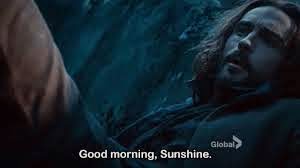
ever in Sleepy Hollow, I don't care. When Ichabod, about to
be killed by Headless, sees the sunlight hit his trouser-leg--“Good
morning, Sunshine” --knowing that now he and Abbie will be safe,
it's breathtakingly beautiful.
 |
| I think that I shall never see/a tree as lovely as this scene. |
A charming exchange between our
witnesses follows. “You're telling me you knew exactly when the
sun would rise?” Abbie asks, understanding at last Crane's hesitation in running after the Horseman. She figures he must have
used some sort of 18th Century wisdom, star knowledge etc.
“You installed a weather
application for me,” Crane replies showing her his phone. “It
also foretells a 15% chance of precipitation” he continues with the most darling
hint of a smirk in his voice.
We then move deep into the heart of our
episode's heart, namely, the relationship between Ichabod and
Abraham. I absolutely adore the fact that the relationship between
these two men is given so much stage. It's one of the most exciting
relationships in the canon, and any amount of time you writers want
to devote deftly to it (and Todd's work on it here is nothing if not
deft) I am totally game for.
But when Crane introduces this B story
and it's relationship to this week's theme, telling us his quest for
the sword must pass through Abraham, “as my life's journey has till
now,” for the reasons listed above, my head wanted to explode.
That said, the entire rest of this act
is gorgeously done. The sparring between Abraham and Crane in
flashback is beautifully choreographed and photographed (thank you so
much, Mr. Aarniovski, for letting us watch it without getting dizzy),
and the relational exposition between the two men is marvelously
handled by writer, director and actors. Many thanks to wardrobe,
hair and makeup, lighting and cinematographers, not to mention their parents'
genes, for rendering both handsome actors exceptionally arresting.
As Crane's mind returns to Abbie and
the present he tells her, “Abraham made me who I am.” Even
Abbie's not fully on board with this B-story. “That's going a bit
far, isn't it?” she asks on behalf of the audience. We conclude
with the very heavy statement, deftly handled by Mison, “we shall
meet in battle again only this time he's the Horseman of Death and I
must know myself completely or perish.”
Well, gosh.
To explain how Abraham even contributed
to Katrina's profound influence on Crane's life, we are treated to a
wonderful flashback of the three in a pub back in the day. All the
actors are marvelous in this scene, but Mison is amazing. He is
beyond believable as a man completely enamored of Katrina, and
devastated to learn she is betrothed to his best friend.
 |
| Um, don't you think I have had a bit of an influence on your life? |
Returning again to Abbie, our hero
laments, “how do I know myself completely when at every turn my
destiny has been determined by others?” Abbie tells him she
struggled with that too, but now she has Grace Dixon's journal and a
destiny (she didn't have a destiny until the journal came along?).
Headless unfortunately took the primary
material clue our heroes need to find the sword, but Abbie—being
Abbie—got a look at it before he did: a steel plate with the design
of a snake eating its tail. “Ouroboros,” Crane tells her. “As
above, so below.”
Professor Crane then hops up on the
ledge above Abbie and begins a romantic lecture on the various
meanings of the symbol (just put Mison on something remotely
resembling a stage and watch him go). Abbie grounds him gorgeously
out of his pedantry with the realization that the clue is literal.
The Witnesses discover, beneath the location of the stolen plaque,
huge metal doors leading into a cave via a stairwell. Keeping with
tradition, Crane's chivalry/feminism insists that Abbie go first into
the most dangerous of situations. You can see from the look on her
face she's getting tired of that.
Down in the cave, our heroes encounter
a most unexpected phenomenon: statues of people from numerous
countries and eras in history. The scene is tense, beautiful, and
builds the mystery well, especially when they find, among the
statues, one of Grace Dixon's daughters or granddaughters. As our
heroes slowly come to realize that the statues are actual people turned to stone, Ichabod's training in Greek
myth comes to their aid. As our Gorgon terrifyingly appears and
chases them up the stairs, and Crane shouts all
Indiana-Jones-like, “don't look back!” it's pretty friggin'
awesome, I daresay. First Greek tragedy and now Greek monsters come
to Sleepy Hollow! Whoo-hoo!
As Abbie tries to calm her nerves,
Crane's mind wanders off through an absurd thicket. Noting that the
people turned to stone by looking in the Gorgon's face included
explorers from multiple nations and various times, he proposes,
“perhaps the very founding of the New World was but a by-product of
the search for the sword.” Are you just flat-out winking at us
now, Mr. Todd? Or is there a new contest in the writers' room to
break Mison? Instead of trying to choke him with delicious,
elocution-defying speeches, you all have made a pact instead to see
who can give him the most ridiculous thing to say with a straight
face?
Naturally, being Tom Mison, he doesn't
bat an eye.
Abbie speaks for me when she asks him,
incredulous, “that's what you took away from what we just
saw?” Freaking out ever-so-slightly about all the women in her
family cut down in their prime by Moloch's evil, including her stone
ancestor in the cave, Abbie shows rare and real fear that she is
next. Crane tries to valiantly to reassure her, “we must face our
fears as we always do.” But Abbie has a better idea: let someone
with no eyes, who therefore cannot be turned to stone by the Gorgon,
face the monster instead. Namely, Headless. Brilliant.
In a quick cut away to our C story, we
learn that Irving has decided not to rendezvous with Jenny and make a
run for the border; he tells her in a voice message that he's going
to stay underground, and fight.
 |
"I'm not saying you can't make a living playing the shofar
son, only that you might want to keep open other options." |
Meanwhile, in D-Story land, Henry gets out an apocalyptic shofar
back at Fredericks' manor, and Katrina, for the first time ever, gets
to be funny! “It's nice to see that you've taken up an
instrument,” she tells her son. “Perhaps after dinner tonight we can have a
recital.”
Illusion and deception continue to fan
out thematically. With still more extremely efficient, yet
believable, story-telling we learn that Moloch has grown to his full
glory and we're not even going to pretend he's a petulant English boy
anymore. Henry confronts Katrina with the unused poison she mixed
up for killing Moloch. “I hesitated” she tells her son, so at
last now we know why she failed so abysmally in her mission.
Continuing with our theme of identity,
Henry sneers at his mother, “you see yourself as strong. A witch,
a spy, a wife. Time and again your humanity defines you.” I love
how he says it like it's a bad thing. He then tells Katrina how her
use of the mirror inadvertently betrayed Ichabod, and how she could
have prevented all of this by letting Ichabod (and, presumably, the
Horseman) die, thereby freeing Katrina to raise Jeremy herself. Fond though I am of Crane, I have to admit he has a point. At
last he lifts his enchantment so Katrina can see modern Fredericks
Manor and Moloch for what they truly are--decrepit, and monstrous.
Back at the landing above the Gorgon's
cave, our heroes have been preparing for the next step of their
quest. In a marvelous, hilarious exchange, Ichabod proudly describes
to Abbie how he very creatively fashioned torches from branches and
his socks, dipped in pitch. Unimpressed, Abbie counters drily with the flares she brought.
Alas, the reiteration of the plan, for those who just tuned in, was
annoying and clunky. Couldn't we have just watched it unfold? 'Tis
a lovely moment when Crane reassures Abbie tenderly, “your mother
would be very proud.”
With nightfall, Headless arrives, and
honest-to-God, I cannot believe he again fell for the old “oh,
look! There's the Horseman. Run, Leftenant!” trick. Why does he
suppose his adversaries are still there from this morning? Oh, wait.
This is the guy who let himself believe that Katrina willingly came
back to be the bride of a dead guy who plans to behead her. Never mind.
 |
| "Yeah?! Well at least I still HAVE breath, dude!" |
While Headless obligingly fights the
Gorgon for them, Abbie and Crane run for the sword room where they
find a bakers' dozen of swords surrounding an urn. Crane explains
“we must determine which is the true sword” for any of us who
never saw Raiders of the Lost Ark.
“Right,” Abbie replies. “Cause
getting here just wasn't hard enough.” Sorry, doll. Not for prime time.
Crane's decision to “hold off the
victor [between Abraham and the Gorgon] in battle” while Abbie
looks for the correct sword is great given that he's our hero, and we
so need to see him and Abraham duel again. But given that he has no
chance of defeating the Horseman without the sword, wouldn't it make
more sense for him to stay with Abbie and try to figure out which is
the correct sword? Yeah, I know. Where's the fun in that? Never
mind. On to the duel! But not before Crane-the-Oxford-scholar
hilariously returns to make sure Abbie knows, “it might be a test.
You may only get one chance.”
 |
| Let's hear it for socks and pitch! |
The entire duel between Ichabod and
Abraham is just magnificent. In a gorgeous inversion to the scene
between Henry and Katrina, the cave is enchanted with a spell which
requires all within to show their “truest face.” What does it
mean to our story long-term that Abraham's own face, and not Death's,
is still his most true? I don't know, but any chance to see Jackson
and Mison duel whilst expositing their emotional anguish with the
other I will gladly take. Pass the popcorn.
I loved how, when Ichabod recounts to
his former friend their various mortal duels—wherein each of them
won one, and one was left a draw--he conveniently leaves out the one
where Headless defeated him and would have killed him back in
Jefferson's cell were it not for Andy Brooks. Seriously, I didn't
mind at all because it would have ruined the gorgeous narrative, and
I didn't remember it myself till seeing it a second time.
When Ichabod says, “I want redemption
for you Abraham, but all I see is a ghost of the man I once knew,”
and Abraham replies with a completely straight face, “Well,
Ichabod, that is because I am dead!” I wanted to kiss you, Shekel
Guy. How many times did you have to shoot this scene before Mison
and Jackson stopped pissing themselves laughing whenever they got to
that line?
When Abraham blames Ichabod for
stealing his destiny, insisting that “I was supposed to be the hero
of this story, not the villain!” I seriously got chills. These two
actors are so well-matched, and this was one of the best lines, best
directed, best delivered, in Sleepy Hollow history!
Crane draws a very important conclusion
in this scene, which, alas, I did not see or appreciate until the
second or third viewing--namely, that our choices define
us—when he tells Abraham the latter chose to let jealousy get the
better of him, chose to become the Horseman of Death and serve
Moloch, two choices made in an instant which ensured Katrina would
never love him.
Of course, when Bram counters that with
his fairly successful, I think, attempt at head-tripping Ichabod, “have you ever noticed how [Katrina] always returns to me?” I
couldn't help but shout at my TV, “yeah, we have Abraham, and
believe me, we're as tired of it as Crane!”
Whilst Crane and Abraham again
attempt to resolve which is the better man via swordplay, back in the
Room of Too Many Swords, Abbie bravely chooses one, only to have
it—and all the swords—transform into entirely different--breathing--phallic symbols. When Ichabod retreats from Abraham
into the sword room, Abbie gives him
the bad news: “There's no sword.” Continuing our lovely homages
to Raiders of the Lost Ark, there is now, however, a shit-ton
of snakes keeping our heroes company in this underground cavern.
 |
"Let's see...I could kill you, Evil's most dangerous adversaries,
or I can fulfill my inner child's need to go
'nyahh, nyahh, nya nyahh, nyahh.'" |
Enter Abraham, ready to kill
Crane and Abbie, demanding the sword. When the Witnesses convince
him there is no sword, he is about to kill the two of them, but
because he hears the shofar, evidence that Moloch has risen, and the
Apocalypse will finally begin, he doesn't.
Let's pause here a moment. So, rather
than simply killing the two Witnesses, which a) per literature's
Occam's razor, would absolutely have made the most sense and b) would
have been easy, peasy, lemon-squeezy (albeit admittedly rather problematic in
terms of the future of the series), Bram venomously tells Crane that
the latter was right.
“We are the choices we make in the
moment, as you said. And I choose to watch you suffer in hell
looking on for an eternity as I ride with your former wife! I choose
who I am. I am the Horseman of Death!” Okay, excellent—albeit
very fast—attempt to make the unbelievable both believable and interesting. But, seriously, Abraham, I'm pretty sure you just
resigned your commission as Horseman of Death in favor of serving as the
Horseman of Schadenfreude (it's in the Gnostic version of The
Revelation).
When Abraham spits at Crane, “you
have no sword. You are nothing!” you can see in Mison's
magnificent visage that Ichabod believes him. It's a glorious
moment, and extremely important, because Crane has told us throughout
the episode that Abraham has had an undo influence on his identity.
But again, it is sped over so terribly quickly that, for this viewer
it didn't have time to land.
The Horseman leaves our two Witnesses
in decidedly different mental states. While Mison is a marvel
showing us how shaken Crane is from the confrontation with Abraham,
and the realization that the shofar is the trumpet from the Book of
Revelation--“I fear the prophecy was correct. I cannot see the
sword because I do not know myself”--Beharie's Abbie is as cool as the
proverbial cucumber, her confidence in her mission and herself
blocking out all doubt. The distinction in tenor between the two
Witnesses is valuable and important, and I appreciate Nicole
Beharie's consistent and beautiful transformation of Abbie into a
BAMF Witness par excellence, now that she has Grace's journal and a
mission. Yet, I do miss the vulnerability of old Abbie. Like her
meltdown after they first saw the Gorgon, this would have seemed an
appropriate moment for at least some fear to surface.
With Abbie firmly supporting him, Crane
concludes so quickly that I missed it the first time
through that “life is a series of choices.” Abbie tells him he
chose to be a patriot and a hero, not to give up when the world
around him ends, so he decides—so mind-bogglingly fast that we
don't even see it's a choice—that he prefers her version of who he
is to Abraham's, thanks. “It is through your eyes I see myself
most clearly.” Well, yeah, dude! Who wouldn't when that's how a
beautiful, brave woman sees you?!?
And herein lies my primary complaint
with this episode, the primary reason it only made it to #3 on my “Best of
Season 2” list: I found the resolution to this episode's puzzle,
Ichabod Crane asking “who am I?”, wholly unsatisfying and unclear
the first time through. I get that, following such a fabulous
climax, you needed to keep the denouement tight. But if you guys are
going to mess around with really meaningful emotional arcs like “I
don't know who I am”--and I LOVE it when you do—you've got to
make the end of the journey a little less convoluted. I LOVE the
idea that these two don't get easy answers when asking such tough
questions. It gives us a lot of latitude to keeping playing with
their characters moving forward, but more to the point, it's more
interesting writing. But if you're going to take us to the place
that “identity is a series of choices” (which is not how Abbie
got her identity, incidentally), the breakneck pace has got to slow
down enough for this payoff to really land.
Brought back from the brink by his
partner's loyalty and admiration, Crane continues to seek the sword.
He studies his reflection in the urn before him, touches it, realizes
it's oil. Abbie gives him the go-ahead, and
he slowly lowers his torch to the oil, knowing that if he does not,
in fact, know himself completely, they could both be consumed
in a conflagration. And then, just as the torch touches the
oil...it goes out. “Gods wounds,” Crane curses. It's an
adorable moment, given the tense build-up.
Given the solution to the puzzle—which
is marvelous, by the way—it's poetically perfect that it takes
Abbie to figure it out. “What do we have that those different
explorers didn't have?”
Ichabod gets it immediately. “Each
other.”
And let's just pause there for a
moment. What you're actually saying here--that neither Abbie nor
Crane is their “truest” self without the other--is utterly
brilliant, fantastic, wonderful and perfect. It's also kind of huge.
And yet, in our race to conclude, this moment is also damned near obliterated by the incessantly beeping Roadrunner. Bummer.
 |
Is it too soon to start lobbying for Mison to play Aragorn
in the (totally unnecessary) remake of LOTR? |
With both Witnesses' torches touching
the urn, the oil beautifully burns back enough for us all to see the
sword, and we are treated to a gorgeous vision of Arthur...
er, Aragorn...er, Ichabod pulling the sword out of the urn,
announcing that “Moloch shall not rise.” A tight, marvelous
ending leading us straight and excitingly into our mid-season finale.
A beautiful job, all, I just so wish
I'd felt more fulfilled by the exploration of the marvelous theme.
 1.
1.